

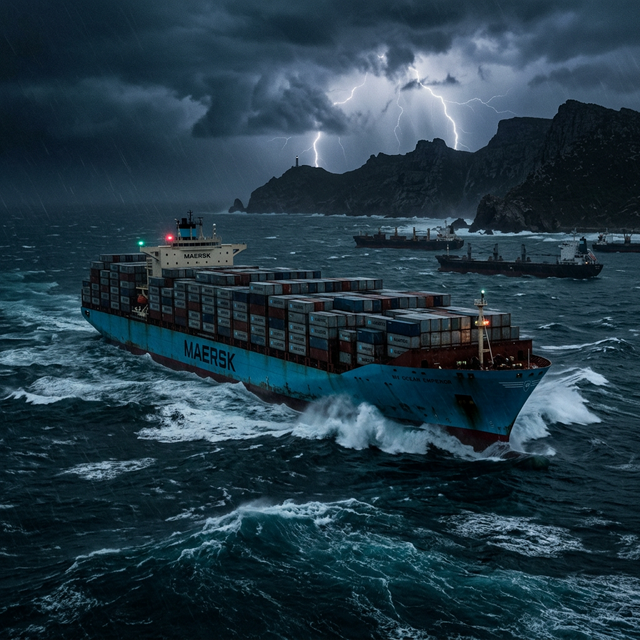
Maersk. Hapag-Lloyd. CMA CGM. All Stopped. The Great Shipping Pause of March 2026 Explained
In the annals of global trade, there are a handful of moments when the entire container shipping industry moves as one. The COVID port crisis. The Ever Given Suez blockage. The Red Sea Houthi disruption of 2024.
March 2026 is the fourth. And it may be the most significant.
A.P. Møller – Mærsk, Hapag-Lloyd, and CMA CGM — three companies that collectively control approximately 46% of global container shipping capacity — have all announced the same decision within 18 hours of each other: all bookings through the Persian Gulf and Arabian Sea are halted or rerouted, effective immediately.
This is not a precautionary advisory. This is a full operational stop.
[!IMPORTANT] Together, Maersk, Hapag-Lloyd, and CMA CGM operate more than 1,800 container vessels with a combined capacity exceeding 8 million TEUs (Twenty-foot Equivalent Units). Their simultaneous operational pause is the largest coordinated commercial shipping withdrawal in recorded peacetime history.
The Cascade of Announcements
March 2, 2026 — 14:22 UTC: Maersk releases an operational advisory citing "active conflict risk zones" and announcing all vessels scheduled to transit the Strait of Hormuz are being rerouted or held at anchor in the Arabian Sea.
March 2, 2026 — 21:55 UTC: Hapag-Lloyd follows with a statement confirming they are "suspending new bookings for Gulf origins and destinations until further notice" and activating Cape of Good Hope contingency routes.
March 3, 2026 — 06:11 UTC: CMA CGM — the French giant — confirms all Middle East Gulf sailings are on hold. Their statement is the bluntest: "The safety of our seafarers and vessels takes absolute precedence over commercial considerations."
By dawn on March 3, the three giants have effectively agreed: the Gulf is off-limits.
What Gets Stuck
The breadth of what moves through these suspended lanes is staggering. It is not just oil. Container shipping through the Gulf carries:
| Category | Key Products | Destination |
|---|---|---|
| Consumer Electronics | Smartphones, TVs, laptops | Asia → Europe, USA |
| Automotive Parts | EV components, ICE engines | Korea/Japan → Global |
| Chemicals | Fertilizers, polymers | Gulf → Asia, Europe |
| Food & Agriculture | Grain, dairy, frozen protein | Global → Gulf states |
| Machinery | Industrial equipment | Europe → Middle East |
The UAE alone imports approximately 90% of its food by sea. With commercial shipping paused, emergency airlift and alternative routing through Oman's southern coast is being evaluated — but neither can match container ship volume.
The Africa Route Economics
Every ship that continues sailing is now adding the Cape of Good Hope detour. Here is what that means in hard numbers:
- Distance added: approximately 3,500–4,500 nautical miles per one-way voyage
- Time added: 10–14 days each way (20–28 days round trip)
- Bunker fuel cost increase: ~$800,000–$1.2 million per voyage (at current fuel prices)
- Effective freight rate inflation: Spot container rates on Asia–Europe lanes have jumped 68% in the first 48 hours
The last time we saw rates jump this fast was January 2024 during the height of the Houthi Red Sea attacks — when Asia-Europe spot rates went from $1,500 to $6,000 per 40-foot container within 8 weeks.
Analysts at Drewry and Xeneta are modeling a similar trajectory now — but with a base that was already elevated from the Red Sea disruption that never fully resolved.
The Insurance Dimension: Lloyd's Moves First
War-risk insurance underwriters at Lloyd's of London issued updated Exclusion Zone notifications on March 2, formally designating the Persian Gulf, Gulf of Oman, and adjacent waters as a Level 1 War Risk Zone — the highest designation, equivalent to what was applied to Crimean waters in 2022.
Under Lloyd's rules, vessels entering Level 1 War Risk Zones without specialized additional coverage are effectively uninsured. No responsible commercial operator will risk $80–200 million in ship value — plus cargo — without coverage.
The insurance change is not just a policy adjustment. It is the mechanism that makes the shipping pause legally rational and effectively self-enforcing.
How Long Do Shipping Halts Last?
Historical reference data from the Red Sea 2024 crisis and COVID port disruptions suggests:
- Phase 1 (0–2 weeks): Chaos. Spot rates surge. Inventories run down. Procurement teams scramble.
- Phase 2 (2–6 weeks): Cape of Good Hope routing becomes normalized. Rates stabilize at higher plateau.
- Phase 3 (6+ weeks): Structural inventory shortages appear in product categories. Retail prices rise visibly.
March 2026 entered Phase 1 approximately 36 hours ago. If the conflict does not de-escalate within two weeks, the global goods economy will enter Phase 2 — with implications that last months past ceasefire.
The three giants paused. The world's supply chains felt it immediately. And the cost of resumption grows with every day that passes.