

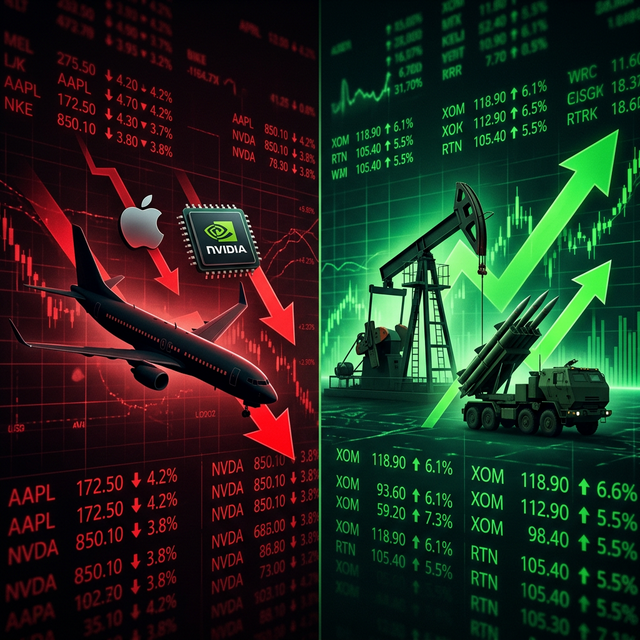
Defense & Oil Up, Airlines & Tech Down: The Complete March 2026 Sector Rotation Playbook
War changes everything about markets — and it changes it fast.
In the first 72 hours following the Iranian strikes of March 3, 2026, the U.S. stock market has undergone the most decisive sector rotation since the COVID crash of March 2020. The underlying economy has not meaningfully changed. Earnings are still the earnings. Revenue is still the revenue.
But the risk framework has completely reset — and capital is flowing from losers to winners with striking speed and clarity.
Here is the complete playbook.
The Losers: Sectors Under Maximum Pressure
Airlines — Down 4–9%
Airlines are the most directly and immediately impacted sector. The combination of:
- Jet fuel cost surge (directly tied to crude oil)
- Route closure risk (Gulf and Middle Eastern routes suspended)
- Demand uncertainty (business and leisure travel pauses during conflict uncertainty)
- Hedging exhaustion (most airline fuel hedges are 60–90 day duration programs)
...creates a perfect storm for airline margins.
| Airline | March 3 Move | 2026 YTD |
|---|---|---|
| American Airlines | -8.9% | -14.2% |
| United Airlines | -6.1% | -9.8% |
| Delta Air Lines | -5.4% | -8.1% |
| Emirates (private) | Operational rerouting announced | — |
| Ryanair | -7.2% | -11.4% |
Dubai-based Emirates — the Gulf's flagship carrier and a critical global hub operator — announced route suspensions and aircraft repositioning, signals that even the most Gulf-integrated airlines are adapting defensively.
Big Tech & AI Infrastructure — Down 3–5%
The narrative around tech is nuanced. This is not a technology-specific crisis, but tech has several specific vulnerabilities in this environment:
Why Nvidia is down ~4%:
- GPU supply chain uses specialty chemicals with Gulf exposure
- Nvidia's largest growth market remains data center AI — which requires stable energy supply
- As bond yields rise (inflation-driven), high-multiple growth stocks face mathematical derating
- Taiwan Strait tensions (China watching U.S. military engagement closely) create additional geopolitical premium
Why Apple is down ~3–4%:
- iPhone 17 Pro supply chain has minor but real Gulf-region component exposure
- Services revenue (App Store, iCloud) has meaningful Middle East geography
- Apple's valuation is extreme at current multiples — any macro shock triggers trimming
Consumer Discretionary — Down 2–4%
War is not good for consumer confidence. Discretionary spending — e-commerce, retail, leisure, home goods — faces pressure from both rational caution and rising fuel/energy costs that compress real disposable income.
The Winners: Sectors With Structural Tailwinds
Oil Majors — Up 3–5%
The clearest, most direct beneficiary.
| Company | March 3 Move | Forward P/E |
|---|---|---|
| ExxonMobil (XOM) | +4.8% | 11.2x |
| Chevron (CVX) | +3.9% | 10.8x |
| Shell (SHEL) | +3.4% | 10.1x |
| TotalEnergies | +3.1% | 9.9x |
| BP | +2.6% | 9.7x |
Oil majors are essentially operating at maximum economic runway. Every dollar crude rises above their production cost ($30–45/barrel for most Gulf-alternative production) flows almost entirely to earnings.
[!TIP] At $100/barrel oil with a ~$38/barrel production cost, ExxonMobil's free cash flow generation enters a tier that makes their forward dividend yield approach 6–7%. This is why institutional capital rotates here aggressively.
Defense Contractors — Up 2–6%
As detailed in our defense analysis: Palantir +5.8%, Lockheed +3.8%, Northrop +4.2%, RTX +2.1%.
Gold Miners — Up 4–8%
Gold itself is near $5,400. Gold mining stocks have a leverage factor to physical gold — a 10% move in gold price often translates to a 20–30% move in mid-cap gold miners as their profitability expands dramatically. Newmont, Barrick, and Agnico Eagle are all having excellent mornings.
Energy Infrastructure and Pipelines — Up 2–4%
MLPs (Master Limited Partnerships) and midstream energy companies that own and operate pipelines, storage facilities, and LNG export terminals inside the United States are in a uniquely valuable position: demand is surging for their services, and their assets are far from the conflict zone.
The Trading Framework: How to Read the Rotation
The signal strength of this rotation is exceptional. When direction is this clear — and fundamentally justified by oil price mechanics — three things typically happen:
-
Momentum extends for 2–4 weeks beyond the initial spike. Even after a ceasefire, defense stocks historically hold gains for 4–6 months as budget reallocations work through procurement systems.
-
The tech dip is a buying opportunity — eventually. But "buying the dip" requires patience. If oil stays elevated, tech's rate-sensitivity headwind persists. The right entry into tech is after oil stabilizes, not before.
Advertisement -
Airlines recover faster than most think if oil retreats. Given their operational leverage, a $15/barrel pullback in crude can restore airline profitability rapidly. This makes them a high-beta recovery play.
The old playbook — buy tech, ignore energy, avoid defense — has been suspended. March 2026 is a reset event.