

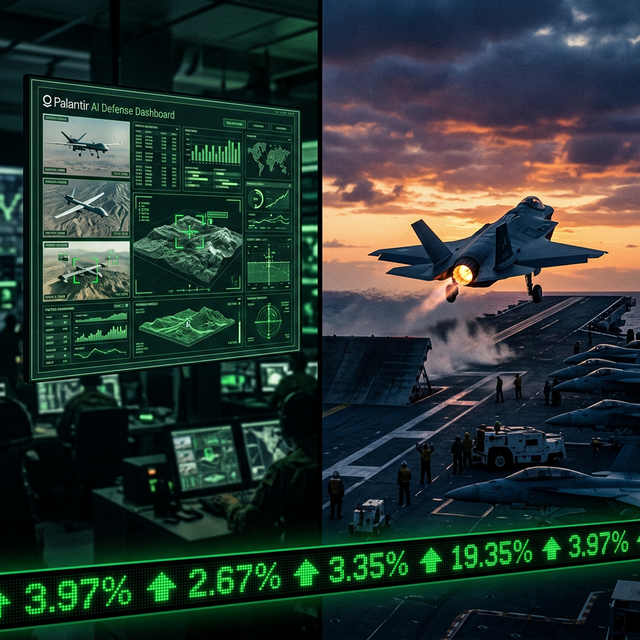
War Is Printing Money for Defense and AI Stocks: Palantir Surges 6%, Lockheed and RTX Climbing
In any war — regardless of its geopolitical complexity, rightness, or resolution — one sector consistently benefits with mathematical certainty: defense and defense-adjacent technology.
March 3, 2026 is no exception.
As S&P futures fell 1.7% and Nasdaq dropped 2.2%, a very different story was playing out in the defense sector. Palantir Technologies surged nearly 6%. Lockheed Martin, Northrop Grumman, and RTX Corporation all posted gains ranging from 2.1% to 4.8%. In pre-market trading, defense ETFs like ITA (iShares U.S. Aerospace & Defense) were up 3.4%.
This is the defense boom. And it is not a fluke.
[!NOTE] Defense contractor revenue is largely government-contracted, recession-resistant, and indexed to geopolitical risk. In a world where every conflict raises the probability of the next defense budget increase, these are structural beneficiaries — not speculative bets.
Understanding Why Palantir Leads
Palantir's near-6% surge is the standout story because it reveals something important about modern defense spending: the category has shifted from hardware to intelligence infrastructure.
Palantir does not build jets or missiles. It builds the AI-powered data platforms that command, analyze, and optimize military operations. In an active conflict environment:
- TITAN (Tactical Intelligence Targeting Access Node) programs accelerate procurement.
- Maven Smart System (in partnership with the U.S. DoD) goes from contract stage to live use.
- Commercial intelligence clients (hedge funds, government agencies, NATO members) increase subscription tier upgrades.
Palantir has a rare characteristic among defense companies: conflict is a live product demonstration. Every engagement where OSINT, satellite imagery analysis, or predictive targeting is used by allied forces is a recruitment poster for Palantir's platform.
The 6% surge reflects the market understanding this dynamic acutely.
The Traditional Defense Giants: The Old Guard Flying High
| Company | March 3 Move | Key Product Exposure |
|---|---|---|
| Lockheed Martin (LMT) | +3.8% | F-35, THAAD, Iron Dome systems |
| Northrop Grumman (NOC) | +4.2% | B-21 Raider, sensor systems |
| RTX Corporation (RTX) | +2.1% | Patriot systems, missile interceptors |
| General Dynamics (GD) | +2.8% | Stryker, submarine systems |
| L3Harris Technologies | +3.1% | Electronic warfare, comms systems |
The pattern is consistent: companies exposed to missile defense, air superiority, and electronic warfare see the largest moves, because these are the capabilities directly relevant to the current conflict theater.
Iron Dome and David's Sling — both with Lockheed/Raytheon (RTX) components — are actively engaged. This is not abstract future revenue. This is live product consumption that will require restocking orders measured in billions of dollars.
The Defense Budget Political Reality
One of the most important factors in the defense sector's structural bullishness is the political impossibility of cutting defense budgets during active conflict.
In 2025, multiple NATO members were already under pressure to meet 2% GDP defense spending commitments. By mid-2025, ten NATO nations had committed to 2.5%. Now, with active strikes and regional escalation in the Gulf, the following are politically and mathematically certain:
- U.S. Supplemental Defense Appropriation: The White House is preparing an emergency supplemental defense spending request, estimated at $45–85 billion, to cover immediate operational costs and restock depleted missile inventories.
- NATO Member Ramp-Ups: Germany, Poland, and the UK have all signaled they are accelerating existing defense procurement timelines.
- Gulf State Purchases: UAE, Saudi Arabia, and Qatar — all facing regional threat elevation — will accelerate procurement from U.S. and European defense firms. F-35 deliveries to the UAE (previously delayed) are being fast-tracked.
Defense spending has zero political resistance in a war environment. Votng against a defense funding bill during active conflict is political suicide in virtually every democratic context. Defense contractors know this — and their stock prices reflect it.
AI Meets Defense: The Emerging "SpeedLayer" Category
Beyond traditional defense contractors, a new category is emerging — companies that provide the AI speed layer for military decision-making:
- Palantir: Data fusion and targeting intelligence
- Anduril Industries (still private as of March 2026, but widely expected to IPO): Autonomous defense systems
- Shield AI: Autonomous pilot software for drones and fighter aircraft
- Rebellion Defense: Cloud-secure AI for classified DoD applications
These companies represent the next generation of defense investment thesis. They are growing at software-company margins while serving defense-company revenue stability. The conflict is accelerating their government procurement cycles from years to months.
The Long Position vs. The Moral Discomfort
Investing in defense during conflict creates genuine ethical tension for many investors. This tension is real and valid. But from a purely analytical standpoint, the investment thesis is unambiguous: governments will spend more on defense, contracts will flow to public companies, and earnings estimates will rise.
For those who invest through ESG-screened portfolios, this creates a sector rotation pressure in the opposite direction — reducing defense exposure at exactly the moment when the sector is fundamentally strongest.
That tension is itself a market dynamic worth understanding. The defense boom of March 2026 is a rational market response to a very real geopolitical shift.