
AI-Driven Diagnostics: The 2026 Breakthroughs
Healthcare is witnessing a paradigm shift from reactive treatment to predictive prevention, driven by the convergence of multi-modal AI and federated learning.
1. Multi-Modal Data Fusion
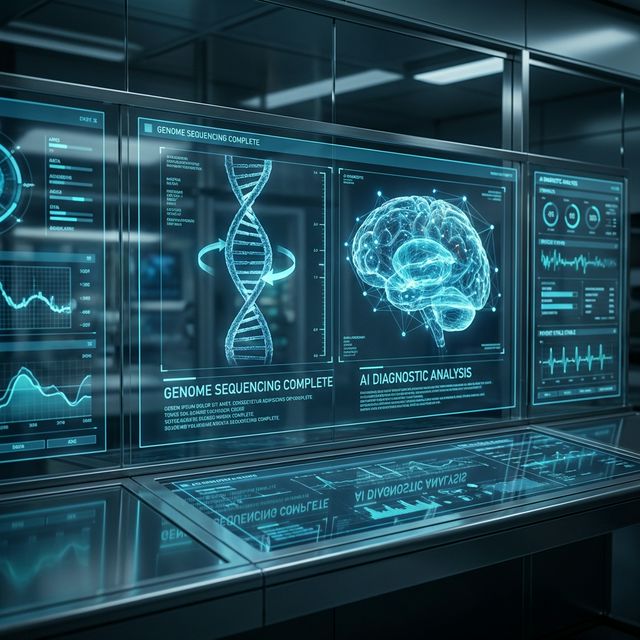
Traditional AI models in healthcare were siloed—analyzing either MRI scans or genomic sequences. The breakthroughs of 2026 are powered by Multi-Modal Fusion Models that ingest:
- Radiology: CT, MRI, X-Ray pixel data
- Genomics: DNA/RNA sequencing data
- Clinical Notes: Unstructured EHR text via LLMs
- Vitals: Continuous streams from wearable sensors
By correlating a shadow on an X-ray with a specific gene expression and patient history, these models achieve diagnostic accuracy rates exceeding 99% for complex pathologies like early-stage pancreatic cancer.
2. Federated Learning for Privacy
Data privacy is the biggest bottleneck in medical AI training. Federated Learning (FL) solves this by training models at the edge (i.e., inside the hospital's secure server).
- How it works: The central model is sent to the hospital. The hospital trains it on local patient data. Only the weight updates (mathematical gradients) are sent back to the central server, not the patient data itself.
- Impact: We can now train global models on millions of patients without a single medical record ever leaving the hospital firewall.
3. "N=1" Personalized Medicine
AI is enabling the ultimate goal of medicine: treating the individual, not the average.
- Digital Twins: Creating a bio-simulation of a specific patient to test drug reactions in silico before administering them.
- Dynamic Dosing: AI agents that monitor continuous glucose/blood levels and adjust medication dosages in real-time (e.g., automated insulin loops).
Conclusion
The doctor of 2026 is a centaur—human empathy + machine precision. The stethoscope of the future is an algorithm.
Detailed findings on multi-modal diagnostic accuracy will be published in our Q1 2026 HealthTech Report.